110 or 230 Volts
Why the Difference
I've been considering a post on the 110 or 230 Volt issue for a while. While browsing the Internet I came across a great summary by Borat over at engineering.com. He summarises the issue as:
- Historical reasons. Edison insisted on 110 V (DC) but was convinced by Westinghouse to switch to AC so that transformers (step up/down) could be used. So that became the North American standard. In Europe AEG started with 110 V (following Edison) but at 50 Hz (instead of North American 60 Hz) because it fit neater into the metric system. After WWII the voltage was doubled to 220 V because higher voltages use less copper - which was at a premium. Other countries in the world usually followed the standards of their colonizing powers. The proliferation of 110 V receptacles and devices in North America prevented the doubling of voltage but that is one of the reasons your large appliances use 220-240V plugs.
World Wide Breakdown
A bit more Googling found this Wikipedia image. The image graphically shows a comparison of various voltages between different countries.
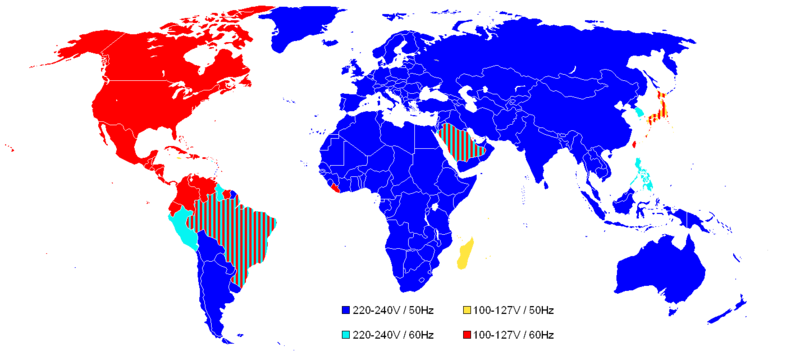
Source: Wikipedia
http://en.wikipedia.org/wiki/File:WorldMap_Voltage%26Frequency.png

Time to Reconsider a Single Worldwide Voltage Standard
There must be be massive advantages to standardisation on a single world wide voltage. Equipment would only need to be designed, built and tested for one voltage. Supply systems would only need to be designed, installed and testing for a single voltage. Standardisation would be simplified by only having to deal with on voltage.
With the world becoming more interconnected with a rapid increase in transfers of skills and materials across countries is it not time to reconsider the adoption of a single world voltage.
The Best Voltage
National pride and arguments on installed systems etc. are the biggest obstacle to agreeing on a standard single worldwide voltage. Sooner or later surely these need to be overcome.
In looking at a standard level for a world voltage, I think there is an argument for considering the IEC accepted level of 230 V. It appears to me that this voltage level has a significant number of advantages over 110 V:
- there is a significant amount of international IEC standardisation based around 230 V
- most countries are already operating at this voltage (or very close to it)
- most residential/commercial equipment can be operated satisfactorily at this voltage
- losses and material usage is reduced, making it a more sustainable selection
And Sockets
Assuming a universal adoption of 230 V, I also think the UK type square 3-pin plug would be a good choice for a common socket. Currently this is only used on 230 V systems, has integrated earthing facilities, is a proven safe design and would be easily recognised. Other socket outlets don't have all these features. In addition, given the visual similarity between many other outlets (even if they are different) could make their use more confusing in the long run.
Will it happen
Given that we still do not have universal adoption of the SI system, my guess for a universal domestic voltage is that this is probably unlikely in the near future. This is unfortunate as the long term benefits would significantly outweigh any short/medium term disruptions in implementing a common system.