Motor Starting - Star Delta
Having looked at DOL starting in the last article, we will now consider Star Delta Starting (or Wye/Delta in the US). This is the first reduced voltage starting method we will review.
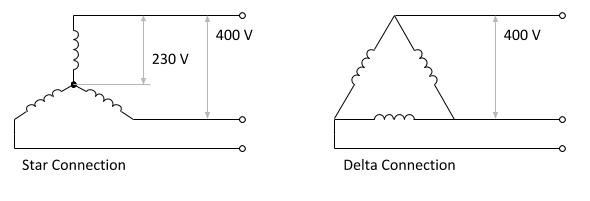
Star Delta Connections
Voltage reduction during star-delta starting is achieved by physically reconfiguring the motor windings as illustrated in the above figure. During starting the motor windings are connected in a star configuration and this reduces the voltage across each winding 3. This also reduces the torque by a factor of three (see Motor Starting - Introduction). After a period of time, the winding are reconfigured as delta and the motor runs normally.
Power and Control Circuiting
The circuit below (click for a larger version) illustrate the power and control required to enable star delta starting of a motor. The power circuit also shows the short circuit and overload protective devices.
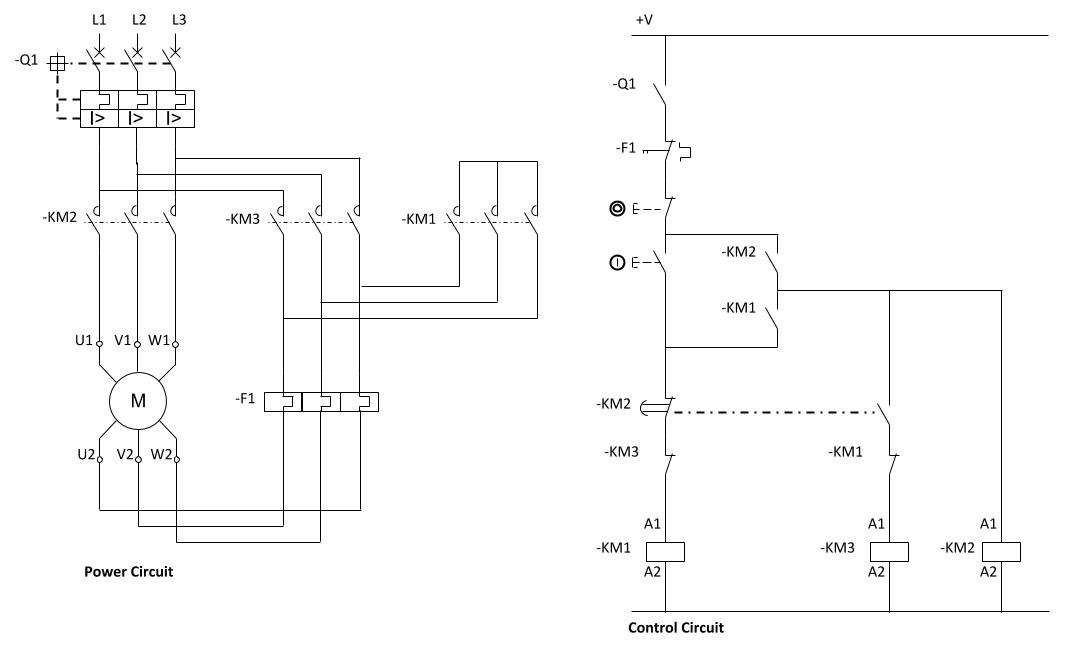
Star Delta Starting Circuit
During operation, the contactor -KM1 is initially closed to put the motor into star configuration. At the same time, -KM2 is closed to apply power to the motor. At the end of the starting period, -KM1 is opened and then -KM3 is closed to place the motor wordings in a delta connection.
Note: this is an open transition starting (see below).
The control circuit is more complicated than that of a DOL starter and is going to take a bit more explaining. When the start button is pressed, -KM1 energises (closing the power contactor) and in turn enables -KM2 to energise putting the motor into star.
After a time delay, the -KM2 time delayed contact will switchover energising -KM3 and putting the motor into delta (while at the same time opening the star contactor).
The time delay is normally adjustable and can be set to match the starting characteristics of the motor and mechanical load.
To avoid shorting the motor, the -KM3 closing contact will close only after the -KM1 contactor is opened - typically around 40 mS. The two contactors are also mechanically interlocked to prevent inadvertent shorting of the motor should something go wrong with the control wiring.
To stop the motor the stop button is pressed, and all power is removed from -KM1, -KM2 and -KM3.
Note: as the motor winding configuration needs to be changed during starting, six cables (cores) are required between the starter and motor.
Open or Closed Transition Starting
At some point during starting it is necessary to change from a star connected winding to a delta connected winding. Power and control circuits can be arranged to this in one of two ways - open transition or closed transition.
In open transition starting, the power is disconnected from the motor while the winding are reconfigured via external switching. This is the method discussed above.
Open transition starting is the easiest to implement in terms or cost and circuitry. If the timing of the changeover is good, this method can work well. In practice though it is often difficult to set the necessary timing to operate correctly and disconnection/reconnection of the supply can cause significant voltage/current transients. So much so that voltage drops and disturbances seen can be worse than if the motor were simply DOL started. For this reason, closed transition is often specified.
Closed Transition Starting
In closed transition, the power is maintained to the motor at all time. This is achieved by introducing resistors to take up the current flow during the winding changeover. A fourth contractor is required to place the resistor in circuit before opening the star contactor and then removing the resistors once the delta contactor is closed.
These resistors need to be sized to carry the motor current. In addition to requiring more switching devices, the control circuit is more complicated due to the need to carry out resistor switching.
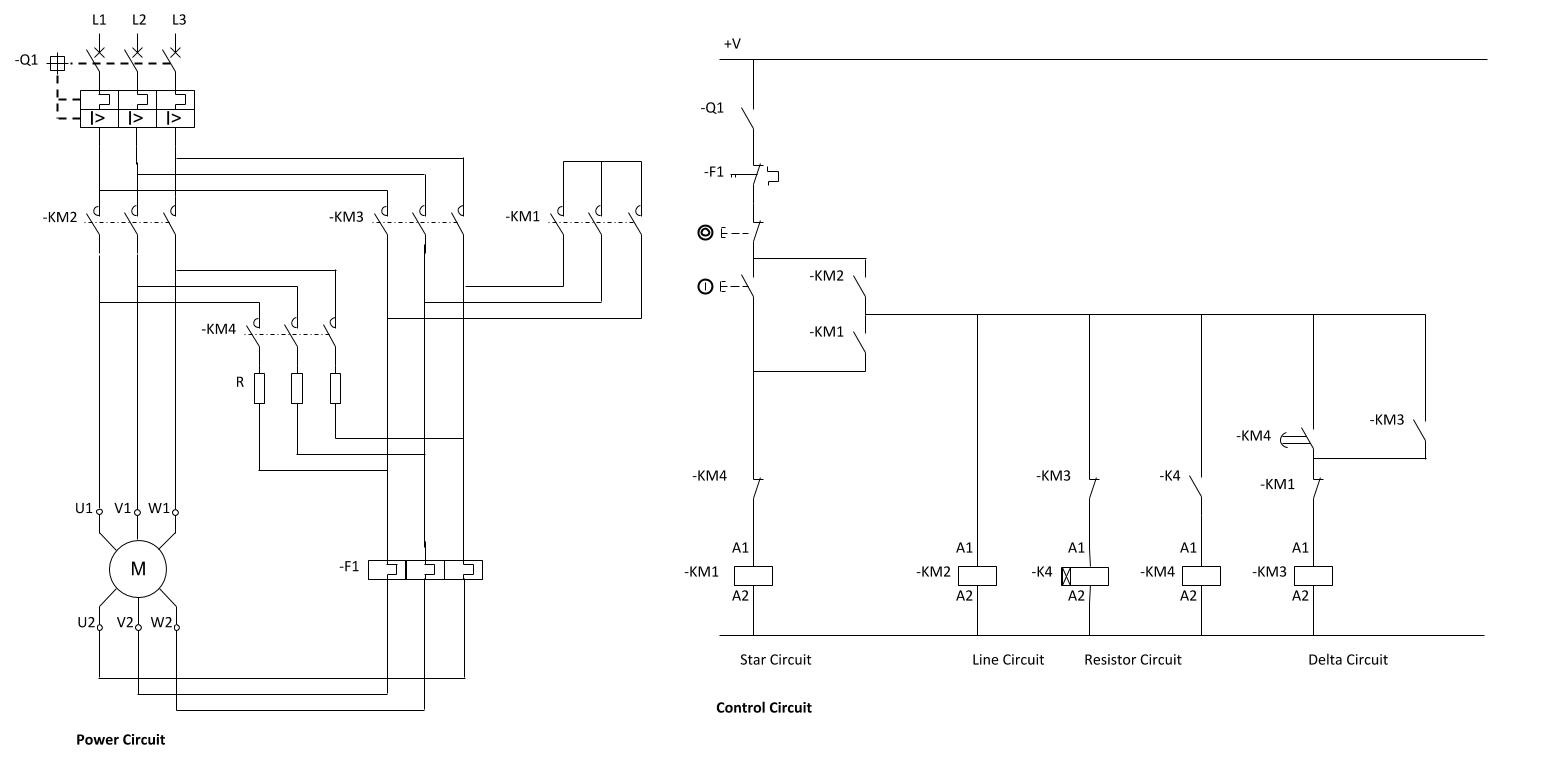
Closed Transition Starter
The diagram (click for a larger image) shows a typical closed transition power and control circuit. Functioning of the starter follows the following:
-
Contactor -KM1 is closed followed by -KM2, which puts the contactor in to star connection.
-
At the end of the star running period, -KM4 closes, placing the resistors in circuit and the motor in star transition.
-
Contactor –KM1 then opens, placing the motor in the delta transition phase.
-
Now -KM3 closes (resistors are shorted and -K14 can be opened), putting the motor into delta configuration.
Note: typically the transition (steps 2and 3) will be 0.1 to 0.5 seconds.
Sizing of the resistors is a compromise between wanting to limit the transition current with the star contactor (-KM1) closed (high a value of R) and avoiding an open transition situation when -KM1 opens (low value of R). As a rule of thumb, the following equation can be used (although for optimum selection, a more detailed analysis is required):
Where:
V – voltage across the motor (in delta)
Ia – locked rotor current of the motor
Resistors also need to be rated to carry the necessary power during the transition, taking into account the likely operating schedule of the motor.
Motor Winding Connection
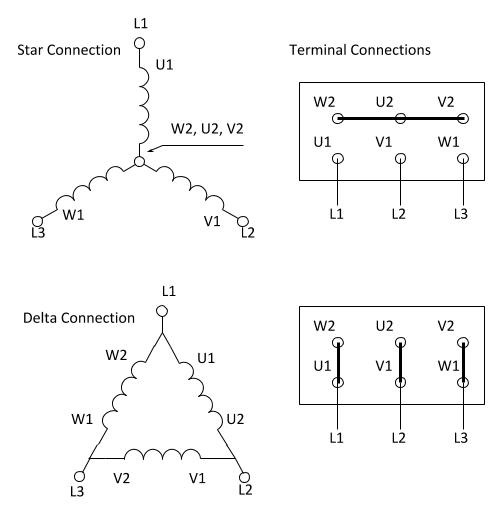
Motor Winding Connections
The ends of all windings need to be brought out for a star-delta connection. Typically these are taken to terminal block, which is labelled U1/U2, V1/V2 and W1/W2 respectively for each winding.
Note: U, V and W are the IEC connection designation. For NEMA connections: U1=1, U2=4, V1=2 V2=5, W1=3, W2=6
The illustration shows typical motor winding connections (click for a larger view). This is not the only way to wire a motor, but it is widely adopted.
After making the connection as shown, the direction of rotation should be clockwise when viewing the shaft face at the drive end. This should be tested with the motor unloaded. If required the direction can be changed by swapping two of the phases.
Motor Starting - Star Delta Characteristics
Available starting current: 33%
Peak starting current: 1.3 to 2.6 In
Peak starting torque: 33%
|
Advantages |
Disadvantages |
|---|---|
| Simple Low Cost Good Torque/Current Performance |
Low Starting Torque Break In Supply - Possible Transients Six Terminal Motor Required |
DOL and Star Delta starters are by far the most common type of motor starting employed. Electronic starting is fast catching up due to other benefits it provides (and I’ll be discussing this later in the series). In the next article, I’ll start reviewing the less common starting methods, first of which will be auto-transformer reduced voltage starting.