Motor Starting - Rotor Resistance
Rotor resistance starting is the second starting method to discuss involving the addition of resistors into the external circuit. In this case, the resistors are connected into the rotor circuit (for connection into the stator circuit see the Motor Starting - Primary Resistance post). This is also the only method I’ll be discussing where you need to get access to the rotor windings; consequently a standard squirrel cage motor cannot be used and a slip-ring motor is required.
During rotor resistance starting, banks of resistors are connected into the rotor circuit at the start. As the motor accelerates, the resistor banks are switched out on timers until at full speed, the motor is running directly connected to the supply.
In rotor resistance starting the torque is nearly proportional to the line current (for example, a starting torque of three times the normal torque will have a starting current of around three times the normal running current).
The requirement for slip-rings on the rotor and switching of resistors banks make rotor resistance starting more expensive and increases the complexity. However, a significant benefit is that the selection of resistors (torque) can be matched to the mechanical requirement of the load.
Power and Control Circuiting
The figure illustrating the power circuit shows how the contactors (-KM11 and -KM12) can be closed in sequence during starting to switch out the resistors. When both contactors are closed the rotor winding is simply connected in its normal running configuration.
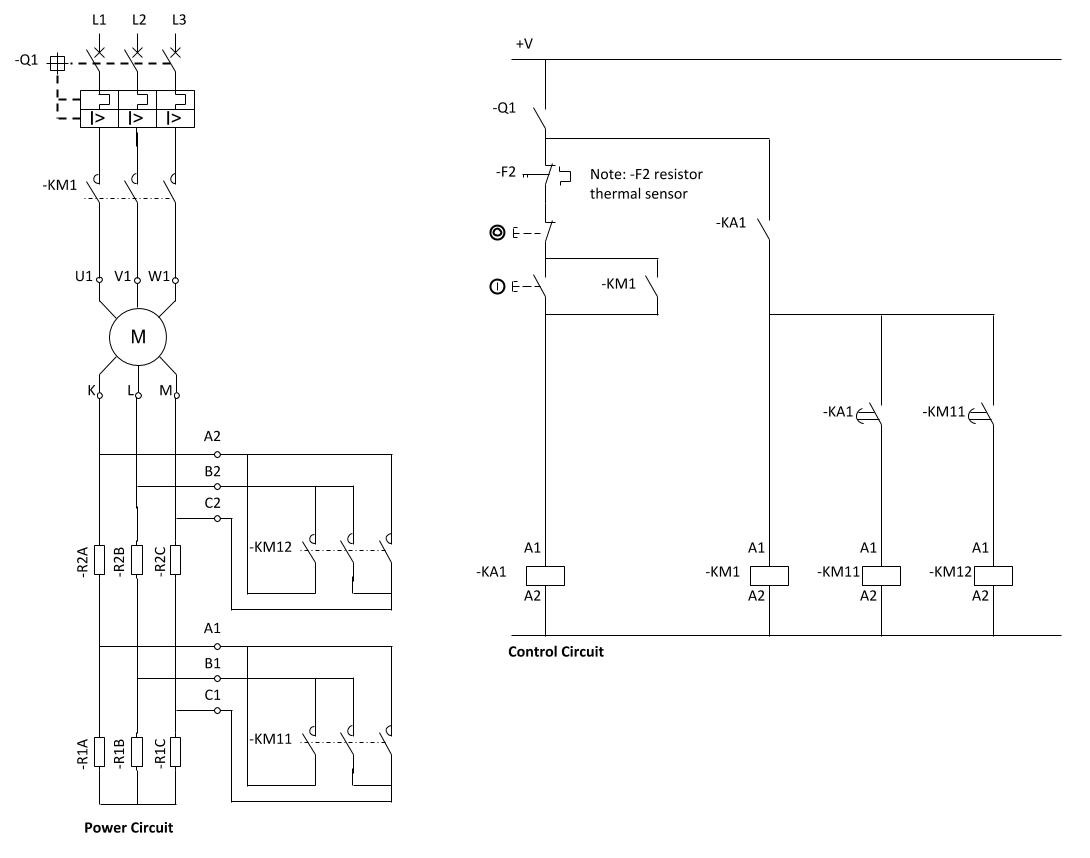
Rotor Resistance Starting
The number and rating of resistor banks is calculated depending on the mechanical requirements of the load.
While the control circuit is relatively straight forward, we need to remember that we are controlling switching of both the stator and rotor windings in this type of starter.
When the start button is pushed, this energises -KA1, switching -KM1 which applies power to the stator and at the same time latches -KA1. -KM11 closes after a fixed time delay, switching out resistor bank 1.
After another delay –KM12 closes and resistor bank 2 is switched out, with the motor fully running. -F2 is a protection device which provided thermal protection of the resistors (effectively limiting the number of starts per hour).
Rotor Resistance Characteristics
Available starting current: 70%
Peak starting current: < 2.5 In
Peak starting torque: ∝ line current
|
Advantages |
Disadvantages |
|---|---|
| Good Starting Current/Torque Performance Adjustable Settings No Break in Motor Supply During Starting |
Expensive Slip Ring Motor Required Resistance Bank Required |