DC Motor Operation 

By on

Coils of wire on the rotor carry a d.c. current which generates a magnetic field. A stator magnetic field is created using either permanent magnets or electrical field windings.

Any current-carrying conductor placed within an external magnetic field experiences a force. Torque is produced in the motor by this mechanism.

As a d.c current provides a constant magnetic field, this needs to change each half revolution and is called commutation. Commutation is typically accomplished by metal brushes against the contacts. Where a field winding is used to generate the stator magnetic field, different motor characteristics can be obtained depending on how this winding is connected.

Operation Principals 
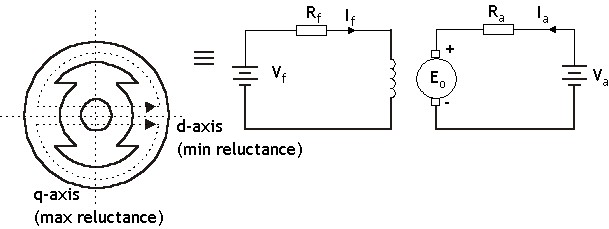
DC Motor Operation PrincipalsFor the equivalent circuit the parameters are given by:

 

myElectrical EquationWhere:

myElectrical Equation       - lap winding

myElectrical Equation -       wave winding

given that

  • n = number of conductor
  • p = number of pole pairs
  • ω = motor speed, rad s-1
  • φ = flux per pole, Wb
  • T = torque Nm
and

myElectrical Equation

The power input to armature is given by:      myElectrical Equation

The armature power loss is given by:           myElectrical Equation

The output power is given by:                         myElectrical Equation

The torque is given by:                                     myElectrical Equation

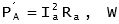
Typically, IaRa is ±3% of Va and the power dissipated in field winding ±3.5% of the motor rating.

Field Windings

Permanent magnets or field windings of a dc motor provide the necessary magnetic fields for the motor to operate(often call excitation):

  • permanent magnets - provides a continuous and constant magnetic field by the use of permanently magnetized materials (typically on only the smallest motors)
  • separately excited - separate windings and power supply provide the magnetic field for the motor
  • shunt winding - this is connected in parallel with the motor armature to provide the excitation
  • series winding - this is connected in series with the motor armature to provide the excitation
  • compound winding - is a hybrid between shunt and series where to field windings are connected both in parallel and in series with the armature

Characteristics of DC Motors
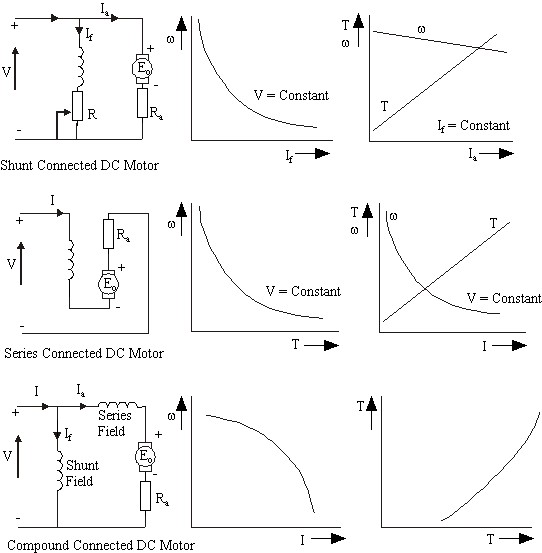
 

Speed Control of DC Motors

Separately excited, shunt

  • Constant power drive - Ia,Va is held constant and If varied
  • Constant torque If is held constant and Ia, Va varied

DC Converter output Voltages

Semi converter,       myElectrical Equation         [DC converter equations do not look correct.  Please can someone check.]     

Full converter, myElectrical Equation - with infinite inductive filtering


Steven McFadyen's avatar Steven McFadyen

Steven has over twenty five years experience working on some of the largest construction projects. He has a deep technical understanding of electrical engineering and is keen to share this knowledge. About the author

myElectrical Engineering

comments powered by Disqus


How to Size Current Transformers

The correct sizing of current transformers is required to ensure satisfactory operation of measuring instruments and protection relays. Several methods...

Motor Efficiency Classification

Electric motors are one of the most widely used items of electrical equipment. Improving motor efficiency benefits include, reduced power demand, lower...

UPS Sizing - Rules of Thumb

It wasn't so long ago I was telling someone that I don't use rules of thumb as most things are easily calculated anyhow.   As it turns out I last week...

Switchboard - Forms of Internal Separation

IEC 61439 'Low-voltage switchgear and controlgear assemblies', specifies standard arrangements of switchboard (call forms of internal separation). The...

How Electrical Circuits Work

If you have no idea how electrical circuits work, or what people mean then they talk about volts and amps, hopefully I can shed a bit light.  I’m intending...

Electromagnetic Compatibility (EMC)

Electromagnetic compatibility (EMC) is the study of coordinating electromagnetic fields give off equipment, with the withstand (compatibility) of other...

Periodic Electrical Installation Inspection – What to Inspect?

This is the second post in a series of two on periodic electrical inspections. In the first post, I discussed how often inspections should be carried out...

What happened to the cable notes?

If you are wondering what happened to our cable notes, the short answer is that we have moved them to myCableEngineering.com.  The "Knowledge Base" at...

myElectrical - Cable Sizing Tool Upgrade

Our IEE cable sizing was wrote a few years ago and had become rough around the edges. I thought it was time to give the tool a service. Unfortunately when...

Resistors

Resistors are electronic components that oppose the flow of current.  Manufactured in various types and ranges they have a wide application to electronics...

Have some knowledge to share

If you have some expert knowledge or experience, why not consider sharing this with our community.  

By writing an electrical note, you will be educating our users and at the same time promoting your expertise within the engineering community.

To get started and understand our policy, you can read our How to Write an Electrical Note