IEC 61439 - The Switchgear Standard 
By on

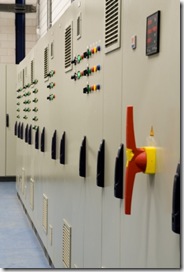
Switchboard_Front
IEC 61439 -
The New Switchgear Standard
The new standard IEC 61439 replaces the old 60439.  Compared to the old standard, the new 61439 is a more clearly defined and takes into account the assembly of pre-tested designs. . 

Some key differences are that the distinction between type tested assemblies (TTA) and partially type tested (PTTA) is gone, verifying the performance is addressed in new ways and the specification of current ratings is updated.  

For more information on testing to the standard, see:

IEC 61439 Verification Methods

Current Ratings

Within the 61439, current ratings are clarified and more clearly defined.t ratings.

  • The standard defines the overall rated current of the assembly (Ina) as the smaller of the sum of  rated currents of incoming circuits or the total current the main busbar is capable of distributing.
  • The rated current of a circuit (Inc) is the rating of a circuit taking in to account the installed devices, disposition and application (and may be lower than the rated current of the devices used).
  • A rated diversity factor (RDF) is assigned by the manufacturer to groups of outgoing circuits which can be simultaneously loaded and takes into account the mutual thermal influence between the circuits.  This can be applied to the whole assembly or a group of circuits.

This clarification of ratings ties the consideration and specification of a switchboard more closely into the manufactured product.  Personally I think is a good thing.  It does put more emphasis on specifiers to understand how the assembly will perform and what they want out of it. 

Typical RDF

The RDF is a figure to be given by manufacturers.  Some typical values I found on the Schneider website are:

Number of main outgoing circuits

Diversity factor

2 and 3

0.9

4 and 5

0.8

6 to 9 inclusive

0.7

10 and more

0.6


Specification of Switchboards

The standard will change how specifiers state their requirements.  Currently specification is often carried out based around devices (i.e. circuit breakers from a particular manufacturer for example), with the device ratings being applied to switchboards.  This is not the case any longer.  There is now a clear need to consider the effect of the enclosure and surrounding components in addition to those of the protective devices and trip units. 

See Also


Steven McFadyen's avatar Steven McFadyen

Steven has over twenty five years experience working on some of the largest construction projects. He has a deep technical understanding of electrical engineering and is keen to share this knowledge. About the author

myElectrical Engineering

comments powered by Disqus


Mobile Phones (Brick to Implant)

The mobile phone was born in 1973. They were the size of a brick and weighed a couple of kg, making them difficult to fit into your pocket. At a few thousand...

Electrical Engineering

Electrical engineering is a field that covers a wide variety of sub-fields, including electricity and electronics. It is a field that goes back to the...

Meeting room of the future

The IET site has a video of a visit showing of a high tech meeting room developed at Napier University in Edinburgh. It a good demonstration of innovative...

Lead us, Warleader

Delum, who had watched all in silence, his face empty of expression, now spoke in turn. ' "Lead us, Warleader, into glory."' Reading is something I do...

Fault Calculations - Typical Equipment Parameters

A frequent problem in fault calculations is the obtaining of equipment parameters.  While it is always preferable to use the actual parameters of the equipment...

IEC 60287 Current Capacity of Cables - An Introduction

IEC 60287 "Calculation of the continuous current rating of cables (100% load factor)" is the International Standard which defines the procedures and equations...

Cable Insulation Properties

Cable insulation is used to provide electrical separation between conductors of  a cable.  During the historical development of cables, numerous types...

Michael Faraday (the father of electrical engineering)

Famed English chemist and physicist Michael Faraday was born on September 22, 1791, in Newington Butts, a suburb of Surrey just south of the London Bridge...

How to Calculate Motor Starting Time

Request to look at induction motor starting time have come up a few times on the site. Hopefully in this post, I give you guys some idea on how to calculate...

Autonomous Vehicle Challenge

Two driverless and solar power vans have departed from Italy on their way to China via the silk road. During the 13,000 kM trip the vans will drive themselves...

Have some knowledge to share

If you have some expert knowledge or experience, why not consider sharing this with our community.  

By writing an electrical note, you will be educating our users and at the same time promoting your expertise within the engineering community.

To get started and understand our policy, you can read our How to Write an Electrical Note