Differential protection, the good old days 
By on


Image reproduced from
'Network Protection and Automation Guide, by Areva
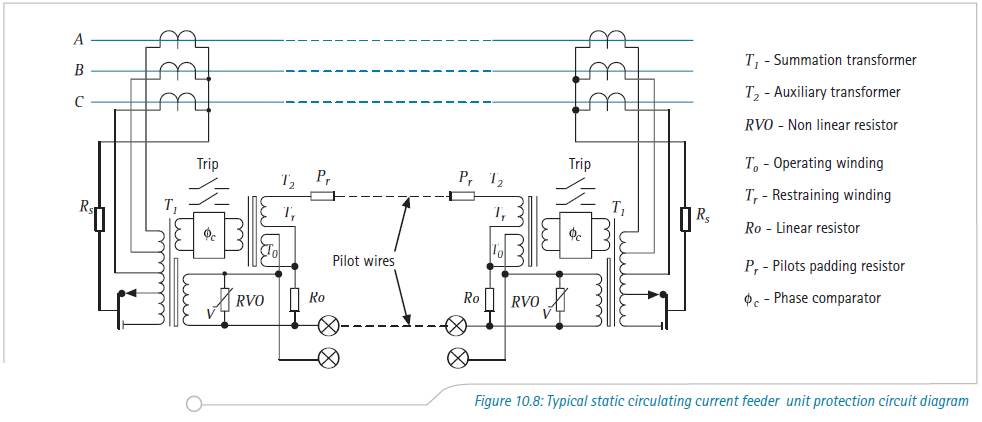
This morning I was explaining how differential protection works to a junior engineer.  To give him something to read I opened up the NPAG (Network Protection and Automation Guide, by Areva) and turned to Chapter 10  ‘Unit Protection of Feeders’.  I was immediately confronted with Marz and Price, circulating current systems, balanced voltage systems, high impedance series connected relays, illustrations like the one shown, etc. ... and remembered my early years.  A time when if you mentioned differential protection to an electrical engineer, they would turn and run in the opposite direction.

Now, I’m not sure if this applies to everyone, but the systems I have been involved with for the past few years have employed numerical relays for differential protection.  Install the two relays, connect together with an optical fibre and gone are all the problems of trying to do this using wires/current between the relays.   I think this is a pretty clear example of how changes in technology have vastly simplified something.  Not only has it simplified the application of differential protection, it also comes with a host of advancements – being able to use CTs manufactured to different specifications as an example.

Numerical relays and optical links may not be the answer to every situation, but I think they make life easier for most of us. 


Steven McFadyen's avatar Steven McFadyen

Steven has over twenty five years experience working on some of the largest construction projects. He has a deep technical understanding of electrical engineering and is keen to share this knowledge. About the author

myElectrical Engineering

comments powered by Disqus


IEC 61439 Verification Methods

The (relatively new) switchgear and control gear standard, IEC 61439 'Low-voltage switchgear and controlgear assemblies' has three methods which can be...

Control Theory

Control theory looks at how systems work and are controlled from a mathematical view.  This note gives a brief introduction to some of the concepts – more...

Introduction to Cathodic Protection

If two dissimilar metals are touching and an external conducting path exists, corrosion of one the metals can take place.  Moisture or other materials...

Harmonised Cable Codes and Colours

Within Europe the European Committee for Electrotechnical Standardization (CENELEC) has standardised the both the designation and colour of cables.   ...

Paternoster Lifts

These lifts were first built in 1884 by J. E. Hall and called a paternoster ("Our Father", the first two words of the Lord's Prayer in Latin) due to its...

Laplace Transform

Laplace transforms and their inverse are a mathematical technique which allows us to solve differential equations, by primarily using algebraic methods...

Copyright Infringement

myElectrical does not support or promote the use of copyrighted material without the copyright owner's consent. If you believe that material for which...

Sony Pocket eBook Reader

For the past few years I have reading eBooks on my HTC touch phone. On and off I have debated buying an eReader and recently purchased a Sony PRS-300 ...

IEC Reference Designations

The IEC publishes a series of documents and rules governing the preparation of documents, drawings and the referencing of equipment.   Depending on country...

Material Properties

Everything physical in electrical engineering from insulations to conductors revolves around materials. Here we are listing common materials along with...

Have some knowledge to share

If you have some expert knowledge or experience, why not consider sharing this with our community.  

By writing an electrical note, you will be educating our users and at the same time promoting your expertise within the engineering community.

To get started and understand our policy, you can read our How to Write an Electrical Note