IEC Document Designation
Often document control is dictated by project requirements, for example a particular organisation may have an existing numbering system. Existing company or group/department document control systems may also be employed. In the absence of any agreed document control, it is recommended that the system detailed in IEC 61355 be followed.
IEC 61355 Document Designation
The IEC 61355 standard provides rules and guidelines for the classification of documents based on their characteristic content for all technical areas which are in use during the life cycle of a plant, system or equipment.
document - fixed and structured amount of information intended for human perception that can be managed and interchanged as a unit between users and systems
DCC - document classification code
A document designation combines a designation of the object to which the document is assigned and the DCC together with a counting number. The document counting number has no meaning other than to differentiate different documents. In addition, this document designation may be supplemented by a page counting number.
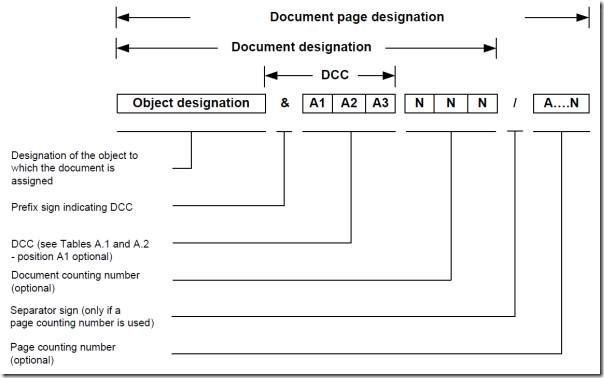
The object designation shall unambiguously specify the object to which a document is assigned. This implies that an object designation shall be (or be made) unambiguous in a specified context. The DDC consists of the prefix sign "&" (ampersand) followed by a code consisting of three letters:
· A1 - letter code for technical area
· A2 - represents class level A2
· A3 - represents class level A3
The page counting number is optional. It shall be separated from the document designation part by the character "/" (solidus), which may be omitted if no confusion is likely (or example when the page counting number is shown in a separate section in the title block ).
It should be noted that within any particular organisation, it is not necessary to implement the full document designation. In particular the DDC could be incorporated as part of an existing document numbering scheme.
IEC 61355 Data Base
The IEC maintain an up to date (and evolving) online database of DDC designations:
IEC 61355 Online Database - as of May 2012, the database did allow free pubic access
The database lists Application Areas (A1 in the DDC) and Activity Areas (A2A3 in the DDC). In order to facility finding the correct DDC, the database allows searching for documents and listing in different formats (by application area, activity area, presentation form, etc.).
Example – to find a DDC for a single line diagram you can search the data base by application area. For electrical engineering the application area (A1) is identified as 'E'. Expanding the list and selecting overview diagrams, show the activity area (A2A3) as 'FA'. The description and examples confirm this is the correct designation to be applied to Single Line Diagrams. The full DDC is then EFA.
See Also
IEC Reference Designations – Opinion post on object designations