Skin Tapping Input 

By on

Skin Input Interface

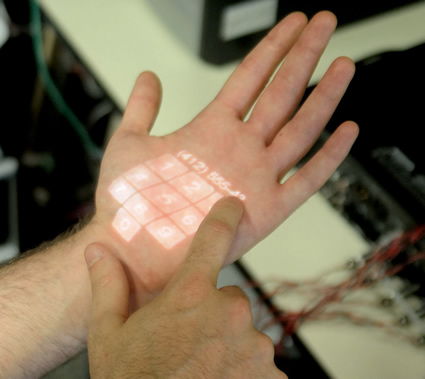
Tapping your forearm or hand with a finger could soon be the way you interact with gadgets. A new technology created by Microsoft and Carnegie Mellon University uses 'body acoustics' to turn skin into an interactive input device.

The continual shrinking of Gadgets is limited by the size of human fingers and the need to interact with the gadgets. An input system such as this one (with some refinement on the size of the armband) may be able to overcome these limitations.

The video explains how it all works.

There is a lot more information on the system developers website at:


Steven McFadyen's avatar Steven McFadyen

Steven has over twenty five years experience working on some of the largest construction projects. He has a deep technical understanding of electrical engineering and is keen to share this knowledge. About the author

myElectrical Engineering

comments powered by Disqus


Voltage Levels – Confused?

I was having a conversation the other day about voltage levels.  While everyone was in agreement that low voltage was 1000 V and less, there was more confusion...

Lithium Ion Battery

Over recent years the Lithium Ion battery has become popular in applications requiring high power densities with small weight and footprint.  Today Lithium...

Cable Insulation Properties

Cable insulation is used to provide electrical separation between conductors of  a cable.  During the historical development of cables, numerous types...

Battery Cars A to Z

Battery powered cars are a hot topic and widely debated. The pros, cons, issues and time frames can be talked about endlessly. An article by the Telegraph...

Cable Sheath and Armour Loss

When sizing cables, the heat generated  by losses within any sheath or armour need to be evaluated. When significant, it becomes a factor to be considered...

Cold Fusion (or not?)

Recently I have seen a few interesting articles on viable cold fusion; the combining of atoms at room like temperatures to create boundless energy. Now...

Differential protection, the good old days

This morning I was explaining how differential protection works to a junior engineer. To give him something to read I opened up the NPAG (Network Protection...

International System of Units (SI System)

The International System of Units (abbreviated SI) is the world's most widely used system of units.  The system consists of a set of units and prefixes...

Understanding Circuit Breaker Markings

IEC 60947 is the circuit breaker standard and covers the marking of breakers in detail. Any manufacturer following this standard should comply with the...

Back to basics - the Watt (or kW)

When thinking about watts (W) or kilowatt (kW = 1000 W) it can be useful too keep in mind the fundamental ideas behind the unit. Watt is not a pure electrical...

Have some knowledge to share

If you have some expert knowledge or experience, why not consider sharing this with our community.  

By writing an electrical note, you will be educating our users and at the same time promoting your expertise within the engineering community.

To get started and understand our policy, you can read our How to Write an Electrical Note